Did I leave you in the grips of anticipation? Have you been clinging to the arms on your easy-chair eagerly waiting? Well, here's the answer: The course that made a huge impression on me was Therapeutic Riding. In the program, we as students, bomb-proofed the horses to use for the disabled children in their physical therapy through the use of horseback riding. About a dozen kids or so signed up to come in once a week on Saturday mornings. They exercised their muscles; increased their flexibility and balance; and in the process added to their overall well-being by helping achieve a sense of freedom, overcoming obstacles, and accomplishing goals. Some of these kids were wheelchair bound and for them to be able to ride and control a horse was nothing less than magical for them.
In the beginning of the semester, this class was very difficult for me because I was required to spend Saturday mornings (8-12) leading horses and spotting the children. Me getting up early on a Saturday morning was pretty much torture. But, as the semester progressed, I got to know the children and their families. As I watched these children transform through this process, I became aware of their progress not only physically, but mentally. It touched my heart and for the first time ever I think, my Saturday morning sacrifice became something more than me. There was a particular mare in the program that I became very attached to. She was a black Quarter Horse mare and she was basically mine. I trained her, I rode her, I lead her for those beautiful children. We were a good team and she was a very special horse.
By the end of the semester, we were ALL were changed. The students, the children, the teacher, the horses, the families, and even the physical therapist were all different coming out of this class. It was an amazing experience to say the least.
After college I trained Missouri Foxtrotter horses...yes horses are just
a part of me. So, when my family decided to buy a farm in 2004, I had a dream
of a therapeutic riding facility. I immediately found a horse (a big, stout, coal black Missouri Foxtrotter mare), paid too
much for her, and then found out she had breathing problems. Oh well...I
think it makes her even better for the program as you don't have to
worry about her running or bucking. Plus, she's kinda disabled herself.
But, as things turned out, financially it just wasn't going to be
possible. My dream got put on hold. Then I met and married my wonderful
husband and we started a family. LIFE CHANGING EVENT. But, horses will always be in my heart, so we bought and traded for a couple of
yearlings in 2007: a black quarter horse filly and a red roan blanketed
Appaloosa gelding. I really wanted to start these two myself, and do it
the way I wanted to. But, it's very hard (impossible really) to train
horses when you're pregnant or carrying an infant on your hip. So the horses and my dream got put off again.
Ok, back to the subject of the title...
-To be continued
Wednesday, September 5, 2012

Tuesday, September 4, 2012
"No Rain, No Pasture, No Hay" part 1
August 2012
Hello! I just want to let anyone reading this that it was written a little while ago and I'm just now getting around to posting it. Thanks!
Due to the drought, our cattle and horses are out of food. If you can find hay, it is very expensive.
Through God's provision, we found 18 large square bales of Prairie Grass from Kansas. I won't tell you what we paid for it... We really need this hay to last the rest of the summer and fall if need be. Downsizing the number of animals is really the only logical choice. We have 7 cows, 2 bulls, 2 steers, 6 calves and 3 horses. Obviously the horses eat the most per head and they do not generate any income. I really need to sell at least one. This thought is really hard for me though. My lifelong passion has always been horses. When I was little, our neighbor had horses and had me in the saddle as soon as I was big enough to hold on. I was 10 when I got my first horse, an American Quarter Horse filly named April. I have many fond memories of our rides together. We were best friends. In college, I took all the horse classes and ended up with a B.S. in Animal Science with emphasis in Equine Science. There was one particular class that made a huge impression on me...
-To Be Continued
Hello! I just want to let anyone reading this that it was written a little while ago and I'm just now getting around to posting it. Thanks!
Due to the drought, our cattle and horses are out of food. If you can find hay, it is very expensive.
Through God's provision, we found 18 large square bales of Prairie Grass from Kansas. I won't tell you what we paid for it... We really need this hay to last the rest of the summer and fall if need be. Downsizing the number of animals is really the only logical choice. We have 7 cows, 2 bulls, 2 steers, 6 calves and 3 horses. Obviously the horses eat the most per head and they do not generate any income. I really need to sell at least one. This thought is really hard for me though. My lifelong passion has always been horses. When I was little, our neighbor had horses and had me in the saddle as soon as I was big enough to hold on. I was 10 when I got my first horse, an American Quarter Horse filly named April. I have many fond memories of our rides together. We were best friends. In college, I took all the horse classes and ended up with a B.S. in Animal Science with emphasis in Equine Science. There was one particular class that made a huge impression on me...
-To Be Continued
Friday, August 31, 2012
Dolly, the Dun Dexter
 |
| Dolly |
The day was Sunday, August 26, 2012.
I just sold one of my first Dexter cows: "Jubilee Farms Dolly" and her 2012 dun heifer. We bought Dolly from a Irish Dexter Show and Sale put on by the American Dexter Cattle Association in May 2004. It seems like she may have even won a ribbon in her class. She was halter broken and lead well. She was also pregnant, very pregnant. That July, she had a dun bull which we promptly named T-Bone. Dolly was a good 'ole cow, she always bred back, never had any health issues or calving problems, always did a wonderful job raising her calf and other than the stillborn twin heifers, gave us a healthy calf every year. You really can't ask more from a cow... Thank you Dolly and we will miss your orneriness!!! Good luck in your new home in Sandy Hook, Mississippi.
p.s. sorry about the hurricane..
 |
| Dolly and Diana, her 2012 heifer |
 | ||||||||||||||||||||||||||||
| Dolly and Delilah, her 2011 heifer |
 |
| Dolly and Dinah, her 2008 heifer |
 |
| Dolly and her 2010 steer |
Saturday, August 4, 2012
Orange Lemonade
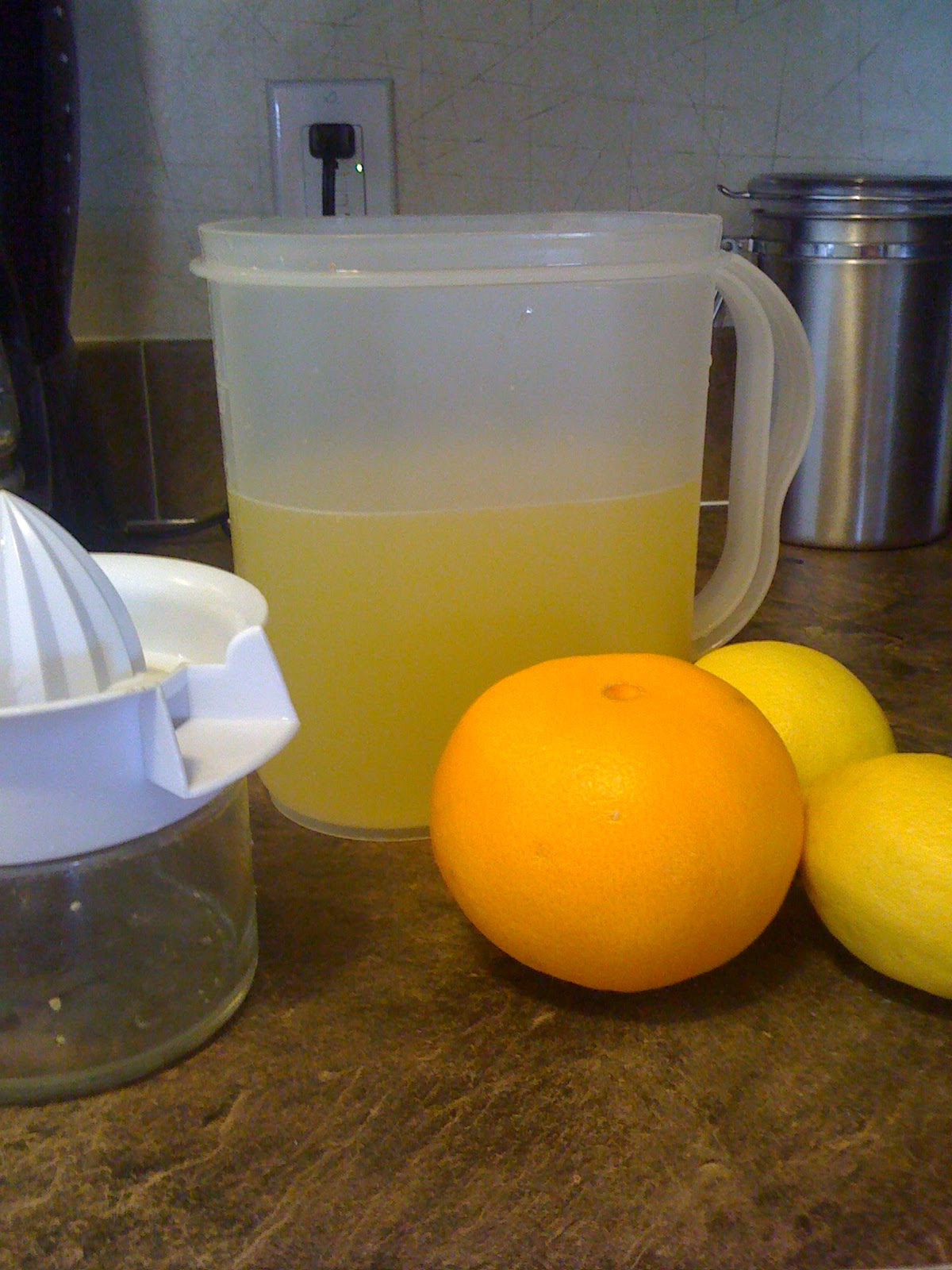 |
| Fresh squeezed orange lemonade |
God Bless
Carie
Trinity Family Farm
Tuesday, July 31, 2012
Onions!
This year is my first successful onion harvest. I am gonna "show and tell" what I did. In early spring, as soon as the ground can be worked, you can start onions. This year spring was early and my onions were started in early February. I actually had leftover onions from last year that I never harvested and they kept growing. (Thank you mild winter!) I replanted them along with the new onion sets I bought I have a raised bed garden and I packed the onion sets in close (3 inches apart) in the 4X8 plot.
 |
| Jadon in the garden Feb 2. 2012 |
 |
| Just harvested |
 |
| " Onion Plait" |
 |
| Hanging in our garage |
 |
| My "best of show" walla walla |
I hope to start growing onions from heirloom seed in the next couple of years. I really like the sweet onions!
God Bless!
Friday, July 27, 2012
Going microwaveless?
Way back in March, on the 21st to be exact, our little 3 year old microwave quit on us. My wonderful fix-it hubby took it apart to see if it might be fixable. Jadon had fun playing with the outer shell, but no, it was a goner as far as cooking food goes. We pondered on the idea of running to wal-mart to get another one, but they just don't make anything built to last more than a few years. Would it be worth it to spend a couple hundred dollars every 3 years to nuke our food? What does that mean anyway? "nuking" It sounds like a very bad term. The freedictionary dot com defines it as this: tr.v. nuked, nuk·ing, nukes
1. To attack with nuclear weapons.
2. To heat in a microwave oven.
It sounds like radiation leading to painful death.
How does a microwave work anyway? In case you have ever wondered...A microwave takes the electricity from a regular wall outlet (110 volts) and via the high voltage transformer, turns it into approximately 3000 volts. This is what it takes for the magnetron tube to convert the high voltage into undulating waves of electromagnetic energy called microwaves.
The frequency used in microwave ovens is the perfect frequency to heat water molecules. (2.45 gigahertz) To review biology: The water molecule has 3 atoms: 2 hydrogen and one oxygen. These atoms share their electrons in such a way that the positive charges are on one side and the negative charges are on the other. The electromagnetic waves produce constantly changing electric fields which forces the water molecule to rotate. Think about magnets and how they attract and repel and how you can move them by the opposing force. In the same way, the water molecules spin at the fastest rate possible, causing heat energy to be released, which in turn, heats the other molecules in the food.
So basically the microwave capitalizes on the water molecule which is found in almost all foods (except obviously dried foods such as rice and pasta which will NOT cook) and uses its specific frequency to heat it up causing the surrounding molecules in the food to also heat up thereby heating it from the "inside out"
In ice the molecules can not rotate as easily, so microwaves do not heat ice as effectively as they heat liquid water. The heated liquid water must heat the frozen water by normal conduction. So frozen foods can heat unevenly.
Does cooking with a microwave damage or alter the food it's cooking? Well, microwaving uses alternating currents, begins within the cells and molecules of foods where the energy transforms into frictional heat which damages the molecules and creates harmful by-products (radiolytic compounds)however, this occurs during direct current cooking as well. Our food changes when we cook it, that's why we cook it.
There are studies that show negative effects of microwaved food. (There were basically two that I could find)
Dr. Hans Hertel, a retired Swiss food scientist, with Bernard Blanc of the Swiss Federal Institute of Technology and the University Institute for Biochemistry, conducted the first clinical study of the effects of microwaved nutrients on human blood and physiology. Dr. Hertel concluded that microwave cooking reduces the nutritional content of foods and creates harmful by-products that lead to blood abnormalities and deterioration in the body. [Valentine, Tom. Search for Health. 1992.] Another doctor, Dr. Lita Lee, adds that microwave ovens leak radiation and cause the following adverse effects in food: Formation of cancer-causing substances, leakage of toxic chemicals from the packaging into the foods, and destruction of nutrients [Lee, Lita, Ph.D. Microwaves and Microwave Ovens. LitaLee.com, 2001].
Food changes when we cook it. It does lose nutrient value whether we cook it in the microwave or on the stove. I do believe that food should not be microwaved in plastics. I also believe that microwaves could possibly leak radiation, so I do not stand near one that is on.
So in conclusion, I am not certain that microwaved food is any more dangerous than grilled, baked, fried, or saute food. However, we decided not to replace our broken microwave. Our new house did not have a formal cubby for a microwave, so we kept ours on top of the fridge, which was terribly inconvenient. I did not want to use up precious counter top space so that was where it had to go. Honestly, I can say that I don't really miss it. I can heat sissy's milk on the stove top in about the same time as the microwave and stove top popcorn is WAAAAAYYY better than that microwave stuff and is well worth the extra effort. Bye Bye microwave!


Saturday, July 21, 2012
Cayenne Pepper Story
Last summer (2011) I planted 2 cayenne pepper plants in one of my raised beds in my garden. Sometime around the end of October, I managed to pick a bunch of flaming red peppers, about a wal-mart bag full. Over the next couple of weeks, I strung them up with a needle and thread and put them in my kitchen to dry. I was hopeful they would be completely dry by Christmas. My plan was to grind them and find some nice spice bottles and give as Christmas gifts to my family. (Cayenne peppers are excellent for digestion as well as boosting your metabolism) So, a couple of days before Christmas, I went to make my now very dry peppers into spice. I have a mini-chopper that I thought would work and sure enough, it did a fairly decent job. I took out most of the seeds that I could, but some managed to work their way in. I didn't think I would need gloves, which was a really bad idea. Also, the lid to my mini-chopper had a small hole in it, which I did not notice immediately. Of course, I inhaled some of the cayenne dust. I washed my hands and used cold water to try and relieve the burning in my nose. (Cold water does NOT work by the way) After that failed attempt to put the fire out, I'm trying to think of what to use and all I can think of is milk and fat. Aaahhhhh....butter!!!! So I dove my fingers in the butter and smothered my nostrils in it. Success! It quit burning after a few minutes, and actually, I forgot all about it as it was time to get dinner ready. But, later that evening, I began to smell something bad...it wasn't the kids....hmmmmm... oh my goodness! The butter had soured that was up my nose! Next thought: how am I going to get melted butter out from inside my nostrils? Answer: warm water on Q-tips.
So, my cayenne pepper spice was a success and I got three large bottles to give away. The peppers are quite hot, but they have a marvelous flavor. A little dab will do in alot of dishes and a good shake in chilli or Mexican dishes.
Advice: ALWAYS wear gloves when dealing with hot peppers; wear a mask when processing them; if you can, process outside or close to an exhaust fan; and if you have safety glasses, it couldn't hurt. And, even with the mask on, after 40 or so peppers, I still sneezed repeatedly! Lastly, don't forget to save a few seeds to replant for next season.
 |
| Cayenne Peppers |
Subscribe to:
Posts (Atom)